
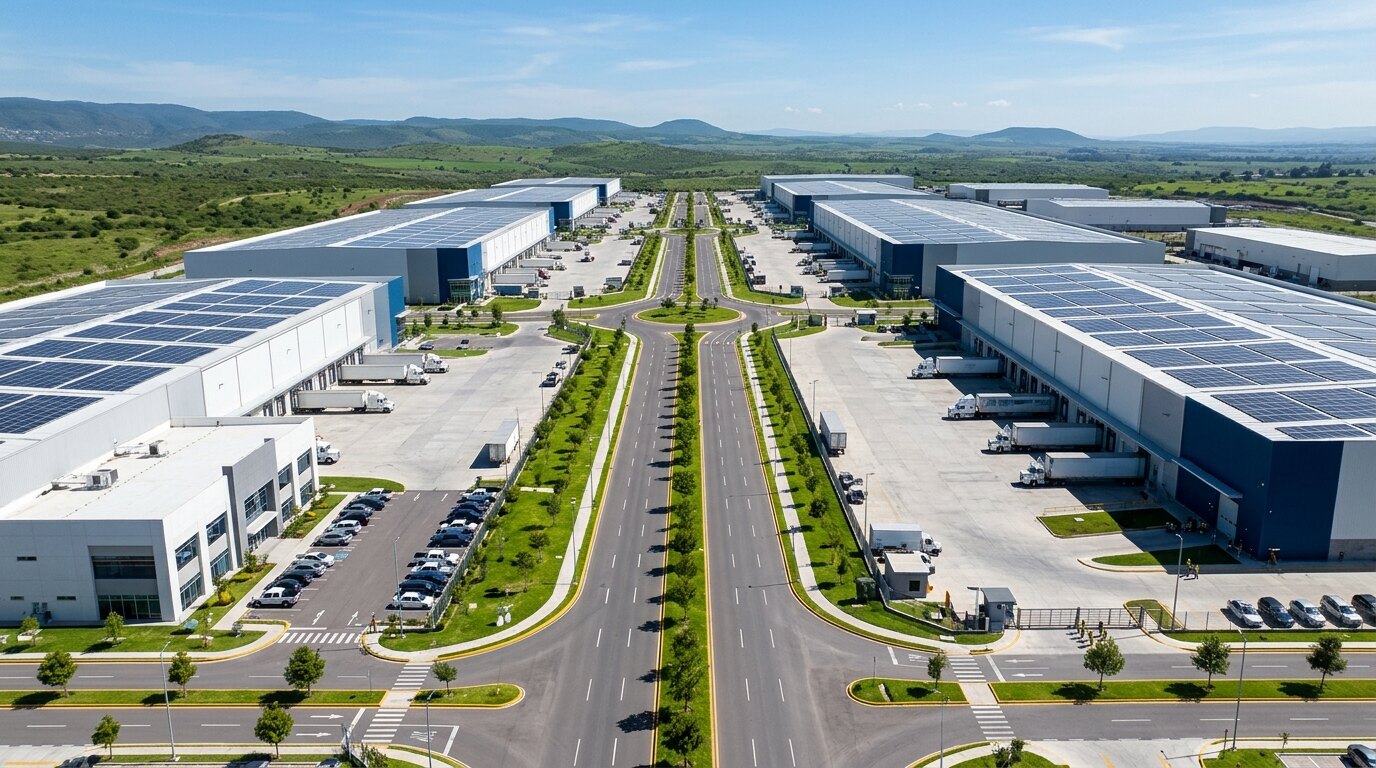
Three numbers explain what's happening with industrial land in Querétaro this fall of 2026.
8.8 million square meters. That's the state's industrial inventory, according to data cited by El Economista at midyear. It grew about 5% in twelve months.
40%. That's how much construction of new industrial buildings fell over the same period. Solili goes further: since the peak at the end of 2023, space under construction in Querétaro has dropped by roughly 76%.
43 projects. That's how many the state government has closed in 2026, with investment of close to 25 billion pesos and around 11,000 committed jobs, according to Sustainable Development Secretary Marco Del Prete in early November.
Put together, those numbers tell a story that is neither the runaway boom of 2022 and 2023 nor the slowdown some predicted. It's the story of a maturing market: companies keep arriving, developers build more cautiously, and the asset becoming scarce isn't the finished building but the land ready to receive one.
Nearshoring is no longer a promise
For a couple of years, "nearshoring" was the word that justified any price. Today it's more useful to see it for what it is: a steady, if less spectacular, flow of companies relocating or expanding operations in Mexico to be closer to the North American market.
In Querétaro that flow has its own features. Automotive remains the sector with the most projects since 2021; the state counts 233 projects and more than 63,000 formal jobs in that period. Add aerospace, electronics, logistics and a sector that barely shows up in other cities: data centers. Querétaro holds 202 of Mexico's 279 megawatts of data center capacity, about 72%, according to figures cited in an analysis published by Expansión in October.
Each of those sectors wants something different from the land. An auto supplier needs a truck yard and trailer access. A data center needs megawatts and water, or a cooling system that doesn't depend on it. A logistics operator needs to be minutes from the highway. But they all share one requirement: they don't have time to wait for a lot to become usable.
Why the finished building is no longer the only star product
At the peak of the cycle, many developers built speculative buildings with no signed tenant, betting demand would follow. Some of that inventory was absorbed quickly; some took longer. The result was rising vacancy nationwide: it reached 5.5% at the end of the third quarter of 2026, according to Solili, far from the record low of 1.8% in 2023. In Querétaro, availability was around 5% at midyear.
In response, the market's mood shifted. Developers prefer build-to-suit, with a signed lease. And to build to suit they need something that can't be improvised: land with industrial zoning, utilities, access and legal certainty.
That's the core point of this article. Well-prepared land can be worth more than a finished building in the wrong place. A generic building competes with dozens just like it. The right lot, in the right corridor, with power sorted out, is the raw material for the projects that will actually get built in the coming years.
What makes an industrial lot in Querétaro "right"
It isn't size. It's a combination that rarely comes complete:
- Current industrial zoning, not "in process" or "feasible with a change."
- Megawatts you can actually get. Today, the toughest filter in the state. More on that below.
- Water, or a viable alternative. Eight of Querétaro's eleven aquifers are overexploited, according to Conagua.
- Access to the highway network: Highway 57, the Northwest Bypass, the Fray Junípero Serra ring road, the road to Chichimequillas or the airport connection.
- Scale and shape that allow a building with a yard, docks and room to grow.
- Clean title, with no pending ejido disputes.
When a lot checks all those boxes, it stops competing on price. It competes on time, and time is what an expanding company is willing to pay for.
The bottleneck: megawatts
If one conversation dominates Querétaro's industrial market today, it's about power. According to Cenace data cited by Expansión, the state's demand reached 1,535 megawatts in 2025, against 723 megawatts of local installed generation. The gap is covered by power arriving over the transmission grid, and that grid has limits. The governor himself has said the state needs around 900 additional megawatts to serve the projects in the pipeline.
Answers are underway. In August, the RLX substation opened in Corregidora, an investment of close to 100 million dollars with more than 1,000 MVA of transformation capacity. In April, CFE reported new protection and metering infrastructure in the capital's industrial zone to improve reliability. But the gap won't close from one year to the next.
The consequence for investors is direct: a lot with allocated power, or a clear path to getting it, can be worth considerably more than an identical lot two kilometers away without it. Buying industrial land in Querétaro without asking about megawatts is like buying a storefront without asking about the door.
Data centers: the new tenant changing the rules
Five years ago nobody talked about megawatts when selling a lot in Colón or El Marqués. Today it's the first question. Data center operators look for large sites with access to high-voltage lines and room to build their own substations, and they're willing to pay for it. Their arrival has put Querétaro on the map of the digital economy, but it has also made land near electrical infrastructure pricier and more contested.
For other industrial users, that has two effects. One is positive: infrastructure built for data centers can strengthen the grid for an entire area. The other demands planning: in some zones, a mid-size factory competes for the same capacity as a hyperscale campus.
The train that's coming and the geography that's shifting
The other factor moving the map is the Mexico City–Querétaro train. At the end of October, the president reported 32% progress. The project spans roughly 232 kilometers with federal investment of around 143 billion pesos, and stations in San Juan del Río and the Querétaro metro area. The latest estimates point to possible completion in the second half of 2027.
It's a passenger train, not freight, so its industrial effect is indirect: it brings talent, executives and service providers closer to Mexico City, and it strengthens San Juan del Río as a hub in the south of the state. For long-horizon land buyers, the southern corridor deserves a look, always with the golden rule: pay for what exists today, not for what the train might bring.
Querétaro next to its neighbors
The Bajío works as a system. Industrial asking rents in Querétaro, Guanajuato and San Luis Potosí are among the most competitive in the country, according to Solili. Each has its own role: Guanajuato with enormous automotive weight, San Luis Potosí as a logistics node to the north, Querétaro with a more diverse mix that includes aerospace, services and the digital economy. Further north, Monterrey plays in another league, with higher rents and a more direct link to the United States.
For an investor, comparing isn't disloyalty to the hub. It's how you find out whether the price asked in Querétaro holds up against what the rest of the corridor offers.
What this moment is not
Let's be clear: this isn't guaranteed appreciation. National vacancy has risen, some buildings take longer to lease than two years ago, and power constraints can stall projects. There are lots marketed as "industrial" that have neither the zoning nor any realistic chance of connecting to power in the near term.
What this moment is, is a selection opportunity. In a euphoric market, almost everything goes up. In a maturing market, the difference between good and bad land becomes visible. That favors buyers with judgment.
Three questions before looking at any lot
- Who would use it? An auto supplier, a logistics operator, a data center, a build-to-suit developer. If you can't name the user, you don't have a thesis yet.
- How fast could that user build? Zoning, power, water and permits decide whether it's six months or three years.
- What if the user doesn't show up soon? The cost of waiting, property tax, security and idle capital, has to fit in your plan.
If all three answers convince you, then it's worth talking price.
This content is for informational purposes only and does not constitute legal, tax, financial or investment advice. Market and investment figures come from reports and public sources available as of November 2026 and may change. Before buying commercial property, land or investment property in Mexico, we recommend validating documentation, zoning, permits, restrictions, project feasibility and legal conditions with qualified professionals.
The images shown are for reference purposes only and may not represent reality.