
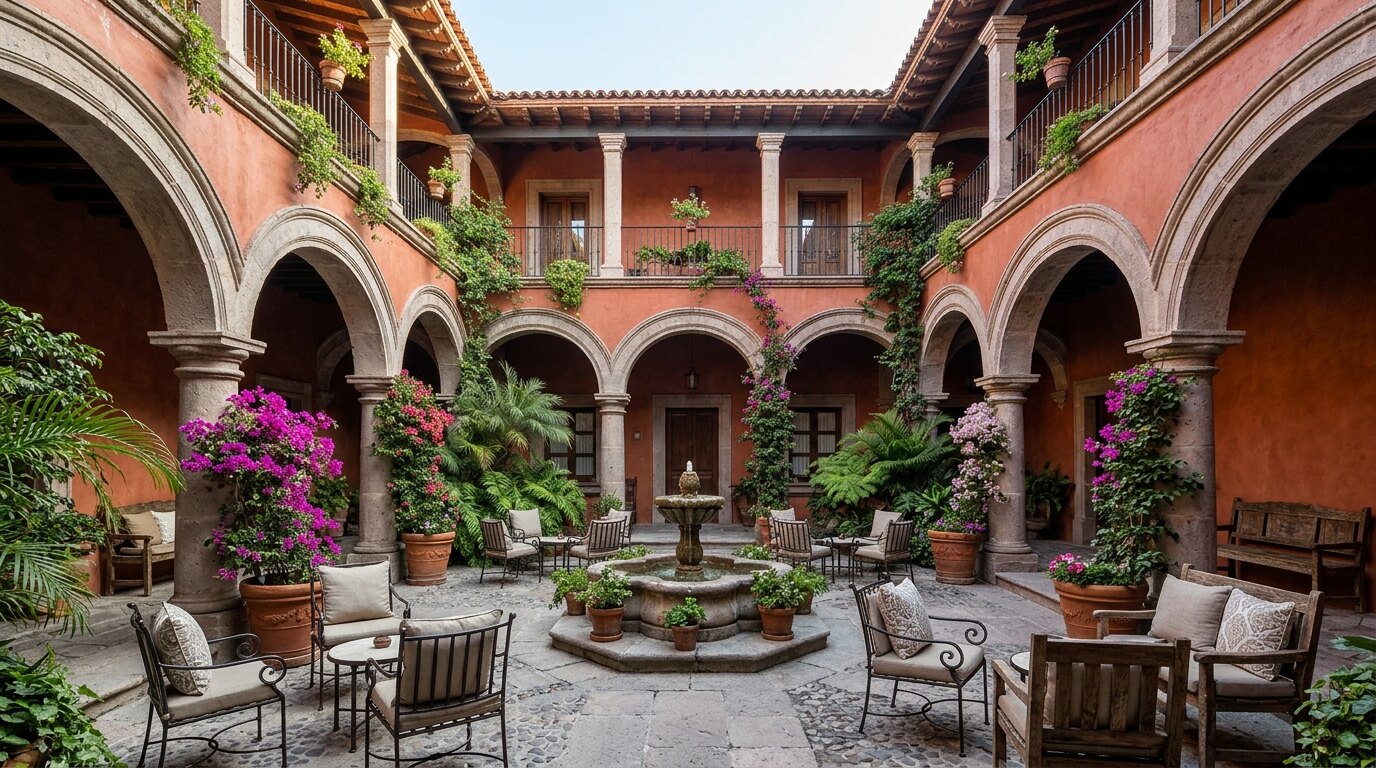
The scene repeats every season. An investor walks through San Miguel de Allende's historic center, steps into a colonial house with a courtyard, stone arches and a terrace facing the Parroquia, and thinks what many have thought before: this could be a boutique hotel. Sometimes they are right. Other times they find out, after signing the deed, that the house fits six rooms when the business needed twelve, that permits take longer than planned, or that the street does not allow the operation they had in mind.
This article is not trying to talk anyone into investing or out of it. It aims to organize the questions worth asking before buying a historic property for hotel use. If you want to see real options as you read, browse the commercial properties in San Miguel de Allende.
A destination with demand, but with clear seasons
San Miguel de Allende was added to UNESCO's World Heritage List in 2008, together with the Sanctuary of Atotonilco, and has since become one of Mexico's best-known cultural destinations. Weddings, weekend visitors from Mexico City and Querétaro, international travelers and a resident foreign community support steady demand.
But the key word is season. According to hotel monitoring data from DataTur, run by Mexico's Tourism Ministry, San Miguel de Allende's average occupancy from January to August 2026 was 37.4%, a preliminary figure. Peak dates tell a different story: for the 2026 Day of the Dead long weekend, the municipality reported preliminary occupancy of 99.8%.
For an investor, this means the business is not measured by full weekends but by how the hotel holds up midweek and in quiet months. A financial plan that assumes high-season occupancy all year is flawed from the start.
The competition is no longer just hotels
For years, a boutique hotel in San Miguel competed with other small hotels downtown. Today the field is wider. Local hoteliers have told the press that short-term rental units listed on digital platforms now outnumber hotel rooms in the city. That does not mean there is no room for hotels, but it does mean guests have many alternatives and compare.
At the same time, international brands are arriving. Beyond Rosewood, which has operated in the city for years, Cleviá, part of Marriott's Autograph Collection, opened in 2025; Pueblo Bonito Vantage opened in June 2026 after a reported USD 70 million investment; and 1 Hotel & Homes is targeting a 2027 opening. These openings raise service standards and attract higher-spending guests, which can help the whole destination. They also force an independent boutique hotel to be very clear about why someone would choose it.
A small hotel's edge usually comes from architecture, human scale, a walkable location and personal service that large chains cannot always match. Those qualities come with the building: they cannot be added later.
What the building has to allow
Before falling for a facade, answer one concrete question: how many rooms fit, each with its own bathroom, without altering what cannot be altered?
In a boutique hotel, the key count drives almost everything. With too few rooms, fixed costs such as front desk, housekeeping, maintenance, booking systems and platform commissions weigh too heavily. With too many, the character that justifies the rate is lost. Every project has its own number; what matters is calculating it from floor plans, not by eye.
Historic preservation rules
San Miguel's center lies within a federally protected historic monuments zone. Work on listed buildings, and generally within the protected area, requires approvals from Mexico's National Institute of Anthropology and History (INAH) in addition to municipal permits. In practice, there may be limits on facade changes, heights, materials, interior demolition and additions. It is not an impossible hurdle, but it is a time and cost factor to understand before buying.
Ask the seller for all available information: whether the property is listed, what work has been done and under which permits. Ideally, an architect with restoration experience in San Miguel should review the building before an offer.
Land use and operating license
Not every downtown street allows the same uses. Confirm with the municipality that hotel use is compatible with the lot and which operating license, civil protection and, where relevant, alcohol requirements apply. If the plan includes a restaurant, rooftop bar or events, each has different implications.
The numbers worth requesting
If the property already operates as a hotel or guesthouse, the analysis changes: there is a track record to review. Ask the seller for at least two or three years of basic indicators: monthly occupancy, average daily rate, revenue per available room and sales channels (direct, online travel agencies, wedding planners). Ask for expenses too: payroll, utilities, commissions, maintenance, property tax and insurance.
With that data, the conversation shifts from the beauty of the house to the business. A hotel with strong rates but dependent on one platform carries a different risk than one with direct, repeat guests. If the seller cannot provide organized information, treat the property as a start-up and price it accordingly.
For new projects, build the budget with three separate lines: purchase, restoration and furnishing. Restoring a historic building often brings surprises in systems, moisture and structure, so it is worth keeping a reasonable contingency and not spending it too early.
Operate it or lease it to an operator
Once the property is ready, there are two main paths.
The first is to operate directly: hire staff, manage bookings and absorb all the swings of the business. It gives more control and captures the full margin, but it takes time, experience or a trusted general manager.
The second is to lease the hotel or hand operations to an operator under a fixed, variable or mixed rent agreement. It reduces the owner's workload and seasonal exposure in exchange for sharing results. For investors who do not live in San Miguel, this is often more realistic.
A third, increasingly common route is a hybrid: the owner keeps the property and hires a management company to run it under the owner's brand. Whatever the model, the contract defines the business as much as the building does.
Access and connectivity
Most visitors arrive by road from Mexico City or Querétaro. Querétaro International Airport is about 86 kilometers away, and the Bajío airport in Silao is another common option. For international guests, that distance is part of the trip; for the hotel, it means arranging or coordinating transfers is worthwhile.
Downtown, the challenge is different: cobblestone streets, limited parking and high-season traffic. A hotel with reasonable luggage access and a parking arrangement has a real practical advantage.
When it does not make sense
Some scenarios call for stepping back:
- If the viable room count does not reach break-even at conservative occupancy.
- If the building needs a restoration whose scope is still unknown.
- If hotel use is not confirmed in writing for that lot.
- If the plan depends on events or weddings that the street or local rules do not allow.
San Miguel and the rest of the state
Some investors compare San Miguel with the state capital. Guanajuato city has a different dynamic: a university town with high-profile cultural festivals and a more domestic visitor profile. Entry prices and room rates differ too. If you are weighing both, you can review commercial options in Guanajuato to compare.
Frequently asked questions
How many rooms does a boutique hotel need to be viable?
There is no universal number. It depends on average rate, expected occupancy, staffing costs and the operating model. What matters is running the numbers with conservative assumptions before buying the building.
Can a historic house downtown be expanded?
Sometimes, but additions within the monuments zone require specific approvals and may face limits on height, volume and materials. Review the specific case with a specialized architect before counting on extra square meters.
Is a hotel better than a vacation rental?
They are different businesses. A hotel needs licenses, staff and its own services, but it can build a brand and steadier rates. A vacation rental is simpler to launch, though it competes in a very crowded market. The choice depends on the property, the capital available and how involved the owner wants to be.
Closing thoughts
A boutique hotel in San Miguel de Allende can be a very rewarding investment when the building, the permits and the operating model line up. The work lies in confirming that before signing. To start with real options, review the selection of commercial properties in San Miguel and run these questions on each one.
This content is for informational purposes only and does not constitute legal, tax, financial or investment advice. Figures come from public sources available as of November 2026. Before buying commercial property, land or an investment property in Mexico, verify documentation, zoning, permits, restrictions, project feasibility and legal conditions with qualified professionals. The images shown are for reference purposes only and may not represent reality.