
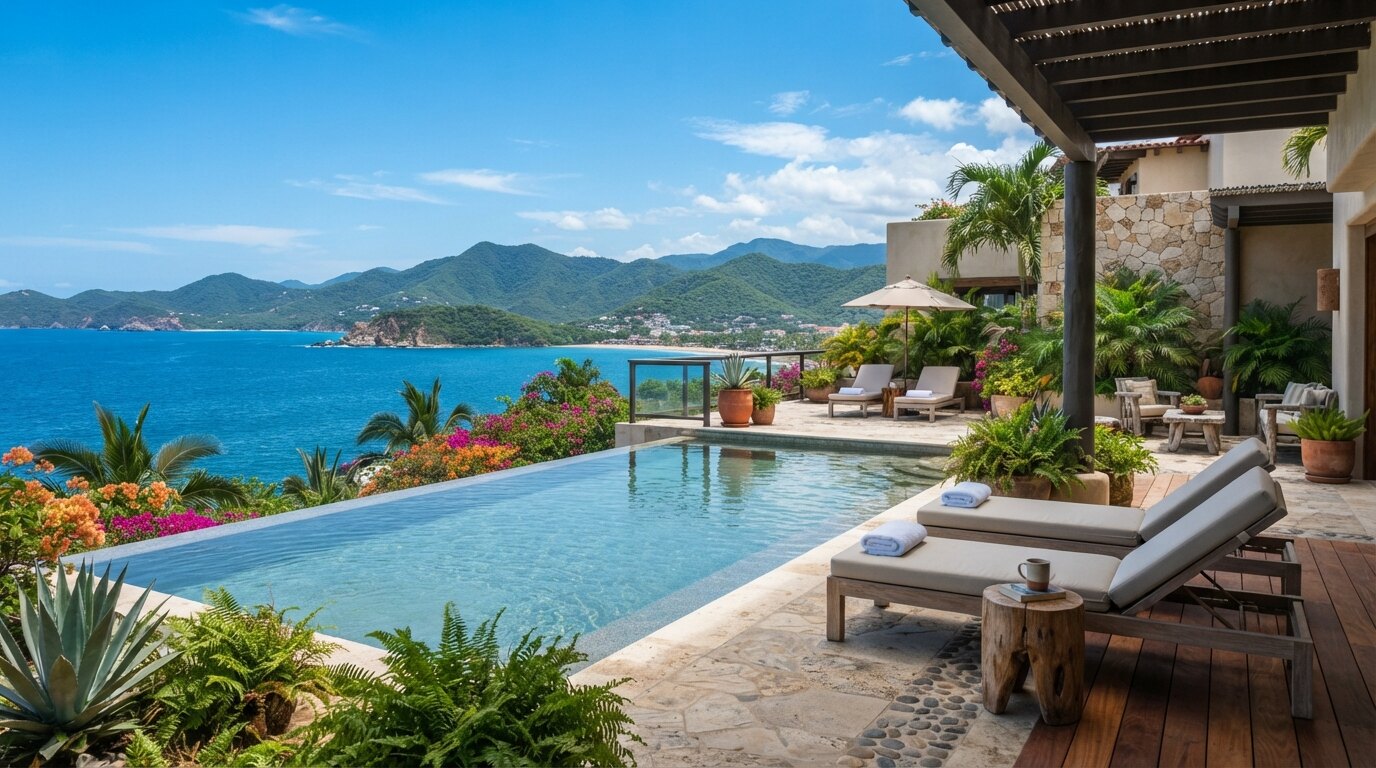
Huatulco is not a conventional beach investment market. Its commercial real estate story is shaped by bays, low-density tourism, boutique hotels, protected natural character and a hospitality rhythm that feels different from larger resort cities. That is why investors should not evaluate Huatulco assets with the same checklist they might use in more saturated destinations.
The opportunity is more selective. Huatulco rewards hotel concepts that understand place, view corridors, access, operations, service quality and the relationship between beach, town and nature. For buyers looking at hospitality real estate, this means a hotel or hotel-use site should be studied as an operating strategy, not only as a property with a good view.
Selva Comercial’s Huatulco commercial property hub shows this clearly. The current inventory includes hotels, beachfront hospitality assets, hotel-use land and commercial spaces. The Huatulco hotels section includes operating and boutique opportunities, while the land section includes sites that can support future hospitality or development concepts.
Why boutique hospitality fits Huatulco
Huatulco’s value is not only in beach access. It is in the way beach access, mountain views, marina activity, quiet bays, walkable areas and nature-based tourism combine. A boutique hotel can benefit from that mix when the property has a clear identity and a realistic operating model. A hotel that depends only on the words “ocean view” may not be enough.
That is why assets such as the 17-room beachfront boutique hotel in Residencial Conejos deserve a different kind of review. The property is not simply a building with rooms. It is an operating hospitality asset with views, privacy, access, amenities and a guest-experience thesis. Buyers should ask how the hotel is positioned, what type of traveler it attracts, what operational costs look like and whether the asset can remain competitive without losing its boutique character.
Beachfront hotels and land are different investment categories
A beachfront hotel and a beachfront development lot may sound similar, but they are not the same investment. A hotel has operating history, staff, maintenance, booking channels, revenue patterns and brand perception. A land parcel has optionality, entitlement questions, development cost, timing and execution risk.
For example, a buyer comparing the Residencial Conejos hotel with a beachfront land parcel in Playa Violín should not ask which one is simply better. The better question is which one fits the buyer’s skill set. An operator may prefer an existing hospitality asset. A developer may prefer land. A long-term investor may compare both, but only after defining capital, timeline and execution capacity.
La Bocana and the hospitality-with-commercial-use angle
Some Huatulco assets are interesting because they combine hospitality and commercial use. The boutique hotel in La Bocana with a ground-floor commercial space is a strong example. A hospitality asset with a commercial component can serve more than guests; it can also interact with local visitors, beach traffic and service demand.
That kind of property requires a sharper operating lens. The buyer should understand not only room performance, but also the role of the commercial space, the relationship to the beach, the pedestrian environment, food and beverage potential, staffing and maintenance. The value is not just the building. The value is how the building participates in the destination.
What serious buyers should review
Before acquiring a Huatulco hotel or hospitality site, buyers should review occupancy assumptions, seasonality, maintenance, permits, utilities, staff availability, guest access, parking, water management, proximity to beaches, nearby services and realistic capital improvements. In boutique hospitality, small operational details can create large differences in performance.
Buyers should also compare operating assets with land opportunities. A hotel-use site near Bahía Santa Cruz and the marina may fit a developer looking for a future concept, while an existing hotel may fit an operator seeking immediate presence. Huatulco offers both, but each one asks for a different strategy.
Huatulco is attractive because it is not generic
The strongest reason to study Huatulco is also the reason investors must be careful: the market has personality. That can create differentiation, but it also means generic hospitality formulas do not always work. A buyer who understands Huatulco’s quieter rhythm, bay structure and boutique visitor profile can make better decisions than a buyer chasing only the coastline.
For hospitality investors, Huatulco is less about maximum density and more about fit. The right asset is the one whose location, operation, scale and guest experience match the destination.
The images shown are for reference purposes only and may not represent reality.