
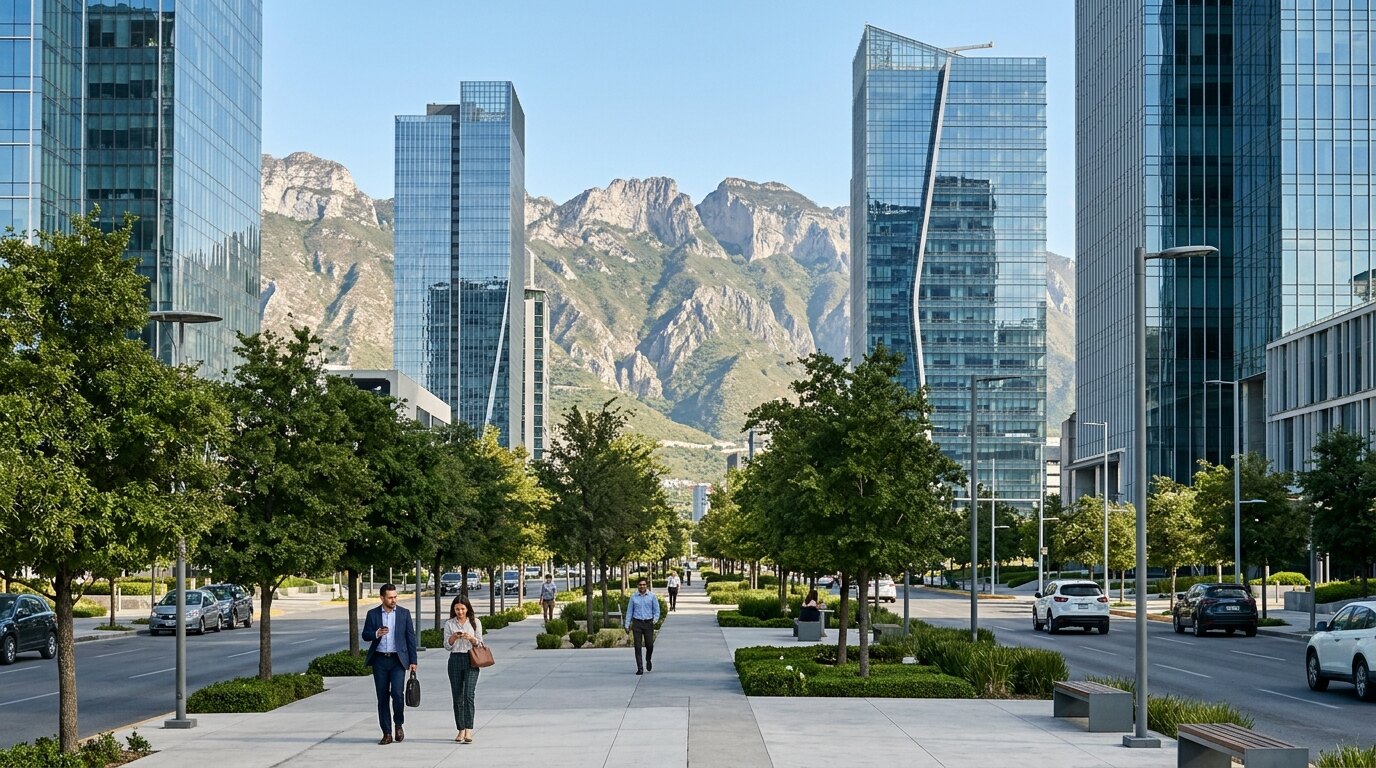
During the pandemic, Monterrey's office market shared a problem with most of the world: too many empty square meters. Six years later, the picture has changed. The factories that arrived with nearshoring need more than warehouses; they need corporate floors, shared service centers, engineering offices and space for suppliers. The numbers reflect it.
This analysis is written for two readers: the investor considering office space to lease out, and the company weighing whether to buy its own space instead of renting. The questions differ, but the underlying data is the same. To see available inventory, visit the Monterrey commercial properties page.
What the numbers say
Real estate consultancies publish quarterly reports with different methodologies, so it is best to read them as trends rather than interchangeable figures.
According to CBRE data reported for the first quarter of 2026, Class A and A+ office inventory in the Monterrey metro area is about 1.47 million square meters, and vacancy fell to 12.3%, an eight-year low. For context, at the start of 2025 vacancy under the same measure stood at 15.6%. JLL, which tracks a different set of completed buildings, reported total inventory above 1.7 million square meters at the end of 2025.
The economic backdrop helps explain the improvement. According to Mexico's Ministry of Economy, Nuevo León was the state with the second-highest foreign direct investment in 2025, at USD 3.628 billion. And the industrial market, which drives much of the office demand, closed the second quarter of 2026 with nearly 18 million square meters and vacancy close to 7%, according to CBRE.
Demand is not evenly spread
The most useful data for a buyer is not the citywide average but how each corridor behaves. Per the same source, Valle Oriente holds about 32% of inventory, followed by Santa María and Margáin–Gómez Morín at roughly 19% each. Corridors such as Margáin–Gómez Morín, Contry and the Centro report single-digit vacancy, while larger availability remains in Santa María and Valle Oriente. San Jerónimo–Constitución holds most of the space under construction.
The corridors, one by one
The table below summarizes the main corridors. It is a qualitative reading; vacancy and pricing change every quarter and should be confirmed with current data for the specific building.
| Corridor | Profile | What to watch |
|---|---|---|
| Valle Oriente (San Pedro) | The benchmark corporate corridor, with mixed-use towers and services | There is available space; building quality and amenities make the difference |
| Margáin–Gómez Morín (San Pedro) | Established corridor with low availability | Fewer options; prices tend to reflect scarcity |
| Santa María | Growth area to the west with several recent projects | Higher availability; check the pace of leasing |
| San Jerónimo–Constitución | Good connectivity and new supply coming | Large deliveries may push vacancy up |
| Centro / Obispado | Close to government, services and transit | Buildings of different generations; check condition and parking |
How to read an office report without getting confused
Quarterly reports are useful, but they rely on terms that are worth understanding before drawing conclusions.
Vacancy is the share of inventory that is available. It says nothing about how long the space has been empty or the condition in which it is delivered. Gross absorption adds up every square meter leased or bought in the period, including moves within the same city. Net absorption subtracts space that was vacated, so it better reflects whether total demand is growing or just moving between buildings. If a corridor shows strong gross absorption but weak net absorption, it is probably winning tenants from other areas rather than attracting new demand.
Building class also matters. Reports from the large consultancies usually track only Class A and A+ buildings, which are one part of the total market. A well-located, well-maintained Class B building can be a good purchase, but its numbers are not in those reports and need to be built from direct comparables.
Finally, the asking rent in reports is what owners request, not what gets signed. Discounts, free months and fit-out allowances change the effective rent, and that data is rarely published.
What to check in the building
Beyond the corridor, the building determines what an office floor is worth ten years from now. These are the points an experienced advisor checks on a site visit:
- Floor efficiency. How many square meters are leasable versus common area. Regular floor plates without columns in the middle adapt better to different tenants.
- Parking. Spaces per 100 m² of leasable area. In Monterrey, a building short on parking loses tenants to the one next door.
- Elevators and access. Peak-hour wait times, access control and reception.
- Backup and systems. Emergency generator, efficient air conditioning and the general condition of building systems.
- Certifications. A building with an environmental certification is better received by multinationals with sustainability targets.
If the building is new, ask for the condominium bylaws, the maintenance budget and the punch list. If it is older, ask about recent capital investments and those still ahead.
For investors: questions before buying to lease
Buying offices to lease in Monterrey can make sense, but the outcome depends on details that do not show from the street.
- Who will lease this space? Manufacturing, technology and corporate service companies have driven recent demand. Ask what kind of tenants occupy the building today and how long their leases run.
- Is it delivered fitted out or in shell condition? A significant share of supply is marketed in shell condition, which means extra investment for the owner or the tenant.
- How strong is the condominium regime? Review fees, reserve fund, bylaws and the quality of building management.
- What is under construction nearby? New supply in the same corridor competes directly for the same tenants.
- Is there enough parking? Car travel is still central in Monterrey; a lack of spaces can be decisive.
Avoid projecting rent from a listing. Ask for comparable leases or recent market reports and make sure the figure you are given is supported.
What leases usually look like
To estimate income from a leased office, it helps to know common market terms. In Monterrey's corporate buildings, rent is often quoted in US dollars per square meter per month, leases run several years and include annual increases, a security deposit and, in many cases, a surety bond or corporate guarantee. Condominium maintenance is usually charged separately.
Each of these points changes the risk. A long lease with a solid company provides stability, but it also locks in rent for years. A short lease lets you reset the price, but raises the odds of vacant periods. Check who pays for the initial fit-out and what happens to it when the tenant leaves: if the office is returned in shell condition, the next lease starts with another investment.
For companies: buy or lease?
Owning offices gives a company control over its space, cost stability and an asset on the balance sheet. Leasing gives flexibility to grow, shrink or move without selling.
Buying usually makes more sense when headcount is stable, the company plans to stay in the same area for many years and can fund the fit-out without straining working capital. Leasing is usually better when growth is uncertain, when the company is still defining its in-office or hybrid model, or when the ideal corridor has little for sale.
A middle path some companies use is to buy one floor or part of a well-managed building and lease extra space as they grow.
Risks worth keeping in view
The market's improvement is real, but it does not remove the risks:
- Construction cycle. If several large projects are delivered at once in one corridor, vacancy can climb again.
- Dependence on the industrial cycle. Much of recent demand is tied to manufacturing; a slowdown there would be felt in offices.
- Building quality. Demand concentrates in well-located, efficient buildings with good amenities. Older generations of buildings can fall behind.
- Operating costs. Maintenance, energy and fees can change actual returns versus projections.
A closing read
Monterrey's office market has left the oversupply phase behind and is now more balanced, with clear differences between corridors. For a buyer, the question is no longer whether Monterrey has demand, but which building, in which corridor and with which tenant. To apply this analysis to specific options, review the offices and commercial spaces available in Monterrey and compare them with the latest quarterly data.
This content is for informational purposes only and does not constitute legal, tax, financial or investment advice. Figures come from public sources available as of November 2026. Before buying commercial property, land or an investment property in Mexico, verify documentation, zoning, permits, restrictions, project feasibility and legal conditions with qualified professionals. The images shown are for reference purposes only and may not represent reality.