
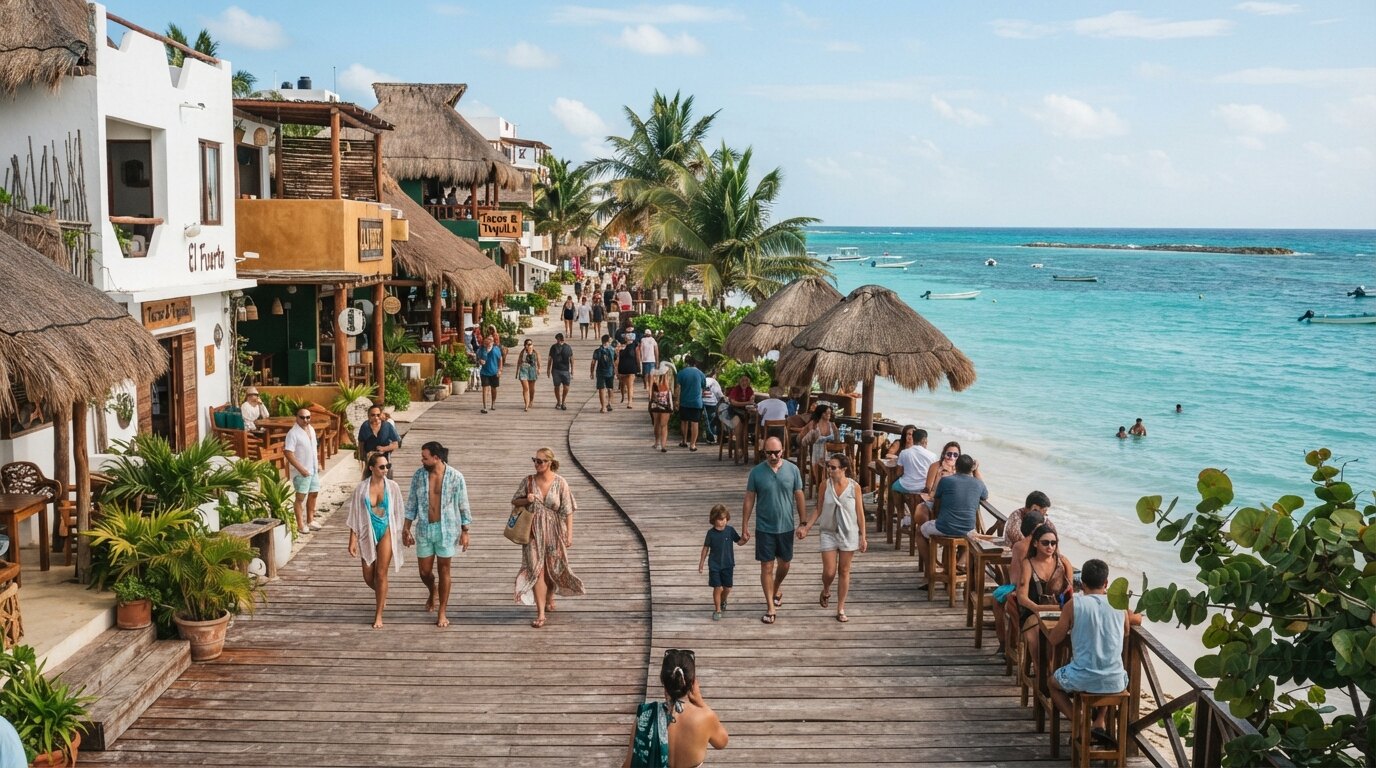
For a long time, many investors looked at Mexico’s Caribbean coast with the same reflex: follow the biggest tourism machine, chase the busiest beach, and assume that more density automatically means more opportunity. Mahahual asks for a different reading. It is still a coastal destination with clear beauty, tourism appeal, and strong land stories, but it is also a market where the conversation around growth now includes environmental balance, infrastructure, community participation, and a more careful approach to hospitality.
That matters for commercial real estate. When a destination begins to talk seriously about ecotourism, public-space improvements, and development that protects its identity, the investor is no longer looking only at a pretty coastline. The investor is looking at what type of product fits the next phase of the market. In Mahahual, that usually points toward lower-density hospitality, land banking with patience, service-oriented commercial uses, and sites that can benefit from future activity without needing to imitate Cancún or Playa del Carmen.
If you are studying the destination, it helps to start with the local inventory. The Mahahual commercial property hub shows a market anchored by land, not by oversupplied vertical inventory. That alone changes the tone of the opportunity. You are not entering a fully matured corridor; you are entering a coastal market where beachfront hospitality land, frontage lots, and larger strategic parcels such as land near the regional airport area can support very different business models.
Mahahual’s appeal is not “small Cancún”
One of the easiest mistakes in emerging coastal markets is copying the wrong benchmark. Mahahual is not compelling because it can become a louder version of somewhere else. Its value is almost the opposite: a destination that still has room to shape its tourism identity. That tends to attract investors who understand the difference between volume and fit. A boutique beachfront hotel, dive-oriented hospitality concept, food and beverage project tied to local traffic, or a land position held for the right phase of infrastructure can make more sense here than a generic copy-paste commercial product.
This is where commercial real estate strategy becomes more nuanced. A market with a strong ecotourism narrative does not reject business; it filters business. Projects that respect carrying capacity, water realities, and local identity are easier to position in the long term than projects that rely on pure density. Investors who study destinations through that lens often make better decisions because they are not just asking, “Can I build?” They are asking, “What kind of operation belongs here?”
Where the commercial opportunity usually appears first
In early-stage coastal destinations, the first obvious opportunities are not always the most sophisticated ones. Demand often forms around services that support visitors, workers, and new hospitality operations: convenience retail, food and beverage, tour-related services, supply logistics, parking, wellness, small-format lodging, and selective mixed-use concepts. In Mahahual, that service layer can be just as important as headline hospitality investment.
That is why land matters so much. A site with visibility and practical access can become more valuable if it sits near a corridor that benefits from future public improvements or rising visitor flow. A beachfront parcel can speak to hotel or tourism use, while a larger inland tract may work as a longer-term land banking play if the surrounding area gains stronger mobility and services. The main point is that the destination rewards matching the product to the market stage.
On the Selva Comercial side, the current inventory already suggests those options. A high-density hotel-use beachfront lot belongs in a different investment conversation than a smaller beachfront lot with 28 meters of frontage. A 40-hectare parcel near the regional airport area is an entirely different game: more strategic, more patient, and potentially linked to broader commercial or tourism-support uses over time.
Why policy signals matter in a market like this
In a mature city, policy announcements are only one layer of the story. In a developing tourism market, they matter more because they influence the direction of future growth. When public narratives begin to emphasize environmental protection, ecotourism, urban improvements, and more coordinated development, investors should pay attention. Not because every announcement becomes instant value, but because it reveals what kinds of projects are likely to make sense in the next phase.
Mahahual stands out precisely because the conversation is not just about more hotel keys. It is also about preserving what gives the destination its identity. For commercial real estate, that can favor businesses that align with the destination’s character: boutique hospitality, food concepts with sense of place, tourism services, wellness, small-scale mixed-use, and land positions that are not dependent on aggressive mass tourism assumptions.
Questions serious buyers should ask before choosing a property
The beauty of a coastal market can distract buyers from the operational questions that actually protect capital. Before moving on a property, ask practical questions. What use is realistic for the site today? What kind of infrastructure already exists, and what remains aspirational? How does access work in high season and in ordinary weeks? What permitting path would a future project require? Is the surrounding demand more seasonal or more stable? How much of the business case depends on appreciation alone?
These questions are especially important when reviewing land. A beachfront property may carry emotional appeal, but the best investment case usually comes from the alignment between use, access, demand, and execution. The same applies to larger inland parcels. Big land can look exciting in a brochure, but it only becomes intelligent when matched with a realistic time horizon and a clear thesis about future activity.
That is one reason many buyers begin by comparing multiple inventory types rather than falling in love with the first postcard view. It helps to review the broader Selva Comercial portfolio, then narrow the focus through the Mahahual destination page and individual listings. That process usually produces a more grounded understanding of where risk and upside actually sit.
The commercial case for patience
Not every good market rewards speed. In places like Mahahual, patience can be part of the strategy. That does not mean waiting passively. It means buying with a clear profile in mind: a parcel for future hospitality, a service-oriented commercial site, a land banking position connected to improving accessibility, or a smaller project that benefits from a more carefully curated visitor economy.
Investors who perform well in emerging destinations tend to do three things. First, they respect the stage of the market. Second, they study the operational reality instead of only the postcard. Third, they choose projects that belong in the destination rather than projects that simply fit a spreadsheet. Mahahual can reward that kind of discipline because its value is not only in what exists now; it is in how the market may evolve if growth stays tied to its environmental and tourism character.
Mahahual may fit investors looking for a different kind of Caribbean thesis
There is nothing wrong with wanting visibility and established traffic. Some investors need exactly that. But others are looking for a destination where they can still read the early signals, secure strategic land, and participate in a less saturated market. That is where Mahahual becomes interesting. The opportunity is not to force it into someone else’s template. The opportunity is to understand how a coastal market with beauty, land availability, and a more selective development narrative can create space for thoughtful commercial real estate.
If your thesis is based on boutique hospitality, tourism services, low-density commercial concepts, or long-term land strategy, Caribe Sur deserves attention. You can start by reviewing the current Mahahual inventory and comparing it with opportunities in nearby Bacalar, where the conversation is also shaped by nature, tourism demand, and land logic.
Explore commercial opportunities in Caribe Sur with Selva Comercial.
From beachfront land in Mahahual to lagoon-front investment properties in Bacalar, our team can help you identify sites that match your commercial or hospitality strategy.
The images shown are for reference purposes only and may not represent reality.