
5:40 a.m. It's still dark on the road to El Marqués. Staff buses line up at the industrial park gate; inside are operators, technicians and supervisors starting the six o'clock shift. Outside, on the corner, a woman already has the café de olla and tamales ready. By quarter past six she'll have sold almost everything.
That scene, repeated at dozens of gates around Querétaro, is the starting point for a real estate opportunity few investors look at closely: the retail and services that grow up around industry.
When people talk about nearshoring, the conversation tends to stop at the buildings. But every plant that opens brings people, and people eat, get sick, buy gas, cash their paychecks, get their cars fixed and, if they come from elsewhere, need somewhere to sleep. Since October 2021, the Querétaro government has counted more than 63,000 formal jobs committed through investment projects; for 2026 alone it estimates around 11,000. Those aren't just industrial numbers. They're customers.
Let's follow a full day to see where the business shows up.
7:30. Shift change and breakfast
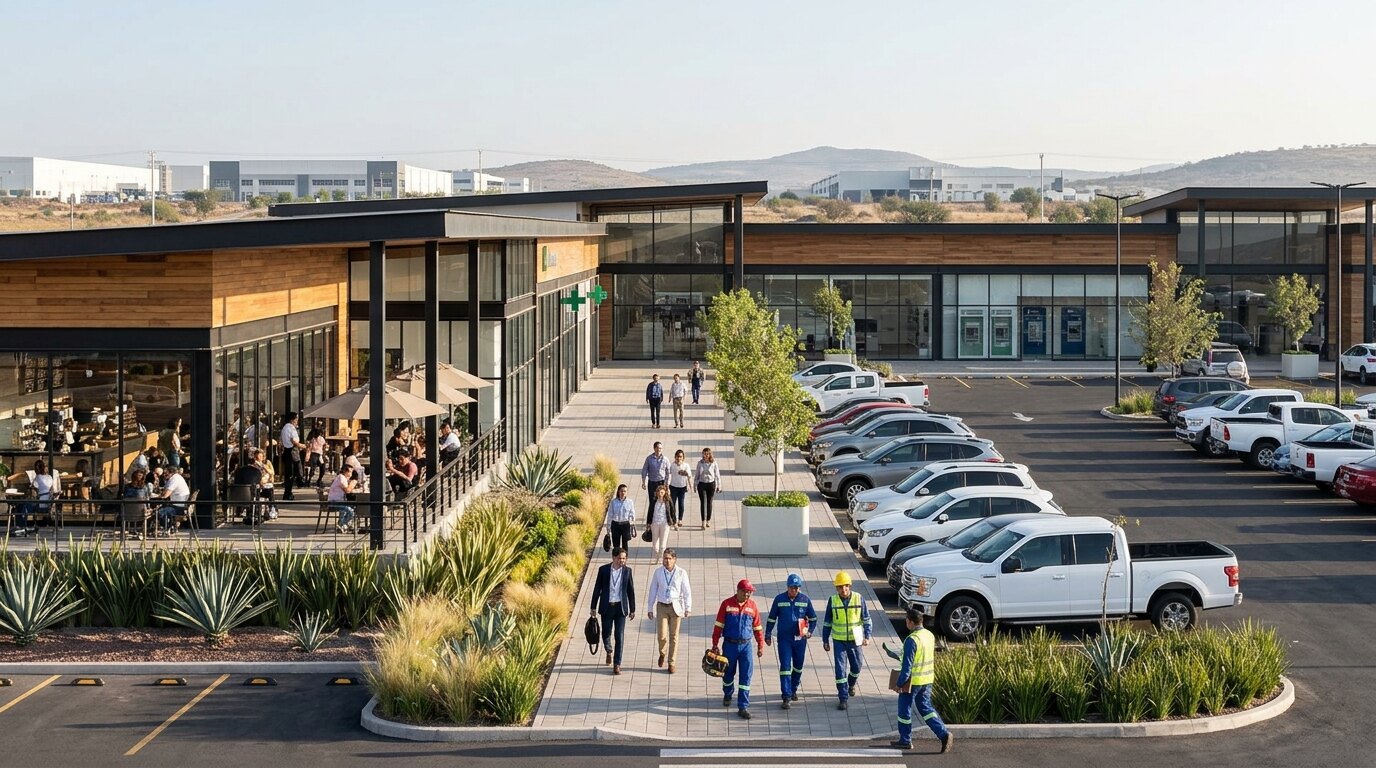
The night shift clocks out. Some head straight home; many stop. A diner, a convenience store, a pharmacy with a doctor's office and an ATM on the same corner capture hundreds of people in an hour.
What this says about the property: the ideal location isn't "near the park," but on the natural route between the park and where people live, on the side of the road they take home. A lot on the wrong side of a divided highway can lose half its potential.
10:00. The suppliers arrive
By mid-morning, traffic changes. Suppliers, maintenance technicians, visiting engineers and sales reps arrive. They need office supplies, spare parts, industrial hardware, printing, a place for a quick meeting. If the park is full of companies from one sector, say automotive, specialized businesses appear: uniforms, safety gear, tools, calibration.
What this says: B2B retail around industrial parks is less visible than consumer retail, but it tends to pay rent on time and faces less competition. Units with a small warehouse and parking for vans are especially useful.
13:30. Lunch
Many plants have cafeterias, but not all, and not all office staff use them. At lunchtime, nearby restaurants with quick service, a daily menu and parking fill up. If they can also deliver to offices inside the park, volume grows.
What this says: a well-located service center with two or three restaurants can have very stable occupancy. Its season doesn't depend on tourism but on the production calendar.
16:00. Errands
Bank, shipping, phone top-ups, a dentist, an optician, a hair salon. People who work far from home take care of their errands near work. In fast-growing areas like the eastern metro, these services often arrive late, and whoever gets there first wins the corner.
18:00. The car
Gas station, car wash, tire shop, mechanic, auto parts. In corridors where most staff drive or ride motorcycles and supplier fleets circulate, automotive services have nearly guaranteed demand. They're also uses that need wide lots and easy access, and they don't always fit in urban centers.
20:00. Somewhere to sleep
The engineers flying in from Germany, Japan or the United States for a two-week installation, the auditors, the technicians training new staff: they all need lodging. Business hotels near industrial corridors and the airport have a very different weekday guest than tourists. And furnished apartments for mid-length stays have become increasingly sought after by companies relocating staff.
In municipalities with heavy industrial activity, such as Colón or El Marqués, executive lodging near the parks is still limited. For an investor with a well-located lot, it's a category worth studying.
What kind of lot works for each business
| Business | Typical size | What matters most |
|---|---|---|
| Convenience store, pharmacy, ATM | Small corner lot | Traffic on the way home and easy access |
| Service center (food, bank, clinics) | Mid-size lot with parking | Visibility, U-turns and proximity to several companies |
| B2B retail (parts, uniforms, hardware) | Unit with storage | Van parking and delivery access |
| Automotive services and gas station | Wide lot fronting a main road | Access, zoning and specific permits |
| Business hotel or mid-stay rentals | Mid-size to large lot | Proximity to parks and airport, services and security |
Who's behind the demand
It's worth remembering where this flow comes from. In 2026, the state reports 43 closed investment projects worth around 25 billion pesos. Some are large industrial plants, like the Riffel group's, which the secretary himself described as an investment of nearly 100 million dollars with about 350 new jobs. Others are services: a lender setting up at the capital's World Trade Center to finance small businesses. That same quarter, AMPIP announced twenty new industrial parks nationwide, one of them a Finsa park in El Marqués.
Each of those announcements is, for service retail, a promise of customers. But it's also an invitation to competition: where one plant arrives, several businesses usually show up at once. Being first on the right corner matters a lot.
The single-plant risk
A frequent case: a strip center built across from the gate of one big factory. While the plant grows, the center fills up. If the company cuts shifts, moves or automates part of its line, the center loses much of its customer base overnight. The way to reduce that risk is to choose locations that serve several parks, a residential area and a road with its own traffic. Three customer sources instead of one.
How to read the area before buying
If you're evaluating a commercial lot near an industrial zone, these observations are worth more than any brochure:
- Count the shifts. A park running three shifts generates retail activity almost around the clock; one with a single office shift, far less.
- Ask how many companies are there and how many are coming. Expanding parks, with buildings under construction, signal more customers.
- See where people live. The subdivisions that feed the parks define the route home, and the route defines the corner.
- Check what already exists. If there's no pharmacy within five kilometers, that's a signal. If there are four, so is that.
- Confirm commercial zoning. Industry next door doesn't mean the lot allows retail. Municipal plans can be very specific.
What tenants of these centers ask for
Pharmacy, convenience and fast-food chains have very concrete criteria: minimum frontage, number of parking spaces, visibility from both directions and, increasingly, room for delivery motorcycles. A lot that meets them attracts tenants with long leases and corporate guarantees. One that doesn't may end up waiting for independent businesses, with more turnover.
Independent operators, on the other hand, focus on something else: whether the rent lets them survive the first months while customers discover them. A center that mixes both kinds of tenant usually has the steadiest occupancy.
An opportunity with less noise
Service retail around industry has an advantage that's not always found in commercial real estate: its demand doesn't depend on tourism, fashion or a single tenant. It depends on the plants staying busy. And in Querétaro, with dozens of investment projects closed every year, that base of activity has held up despite adjustments in the industrial market.
It isn't immune to risk. If a large plant closes or cuts shifts, the center across the road feels it. That's why it pays to favor locations serving several companies and a residential area at the same time, not a single factory.
The same pattern shows up in other industrial hubs. In San Luis Potosí and along the Guanajuato corridor, the areas around automotive parks live a very similar rhythm.
10:00 p.m. Shift change again. The tamale vendor has gone home, but the corner store is still open. Tomorrow at 5:40, it all starts over.
This content is for informational purposes only and does not constitute legal, tax, financial or investment advice. Before buying commercial property, land or investment property in Mexico, we recommend validating documentation, zoning, permits, restrictions, project feasibility and legal conditions with qualified professionals.
The images shown are for reference purposes only and may not represent reality.