
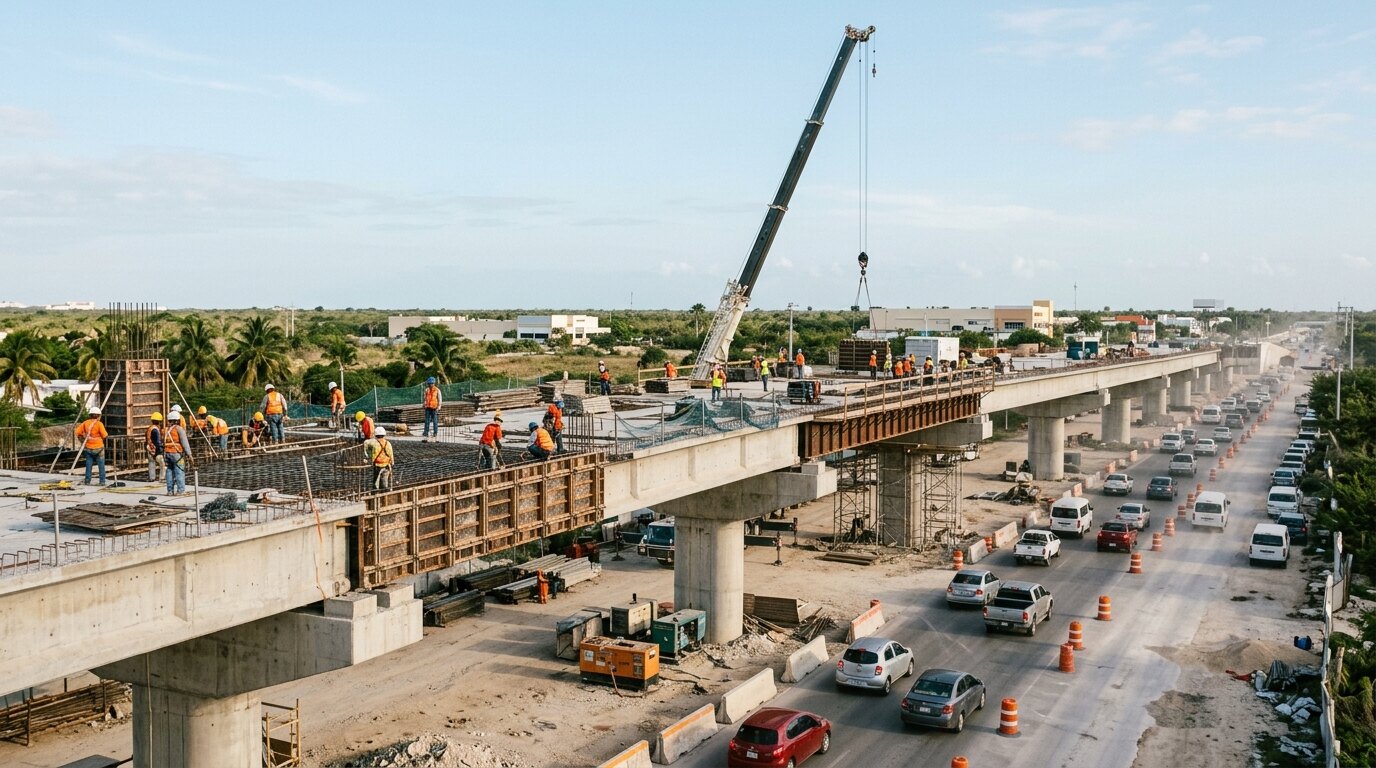
More than 15 billion pesos in road works completed or underway, a rail freight terminal on the way and an electricity investment package for the city. That, broadly, is the tally of public investment reshaping Cancún between 2026 and 2027.
For the commercial real estate market, these projects matter for one concrete reason: they change routes. And when routes change, so does who passes which storefront, which lots gain access and which corridors lose the traffic they took for granted. This analysis reviews each project with public data available as of October 2026 and separates what is confirmed from what is still expectation.
Overview: the headline figures
| Project | Reported investment | Status (Oct. 2026) | Area of impact |
|---|---|---|---|
| Nichupté Vehicular Bridge | ~11.8 billion pesos cumulative | Operating since May | Boulevard Colosio, lagoon, Hotel Zone |
| Kukulcán Interchange | 484 million pesos | ~74% complete; completion expected by year-end | Bridge landing in the Hotel Zone |
| Cancún South Freight Bypass | More than 3 billion pesos | Under construction since July | Huayacán, south, Highway 307, airport |
| Tren Maya freight | Part of the federal program | Operations announced for January 2027 | Southern periphery, freight terminal |
| CFE power infrastructure | More than 551 million pesos for Benito Juárez | Projects presented in August | Citywide, by location |
Methodology note: figures come from releases by the federal infrastructure ministry (SICT), the state government and the Tren Maya company, plus local press reports. Several were updated during construction and should be read as orders of magnitude.
1. Nichupté Bridge
What we know. The bridge opened in early May 2026. It runs about 11.2 kilometers, roughly 8.8 of them as a viaduct over the lagoon system. It links Boulevard Luis Donaldo Colosio with Boulevard Kukulcán and, according to official estimates, cuts the rush-hour trip between the city and the tourist zone from almost an hour to around ten minutes. It is toll-free and includes a bike lane.
What we don't know yet. How traffic will settle once the complementary interchange is finished, and how much it will change residents' spending habits.
Market read. For three decades, the Hotel Zone operated with a single access. That gave certain stretches of Boulevard Kukulcán a captive flow. With a second entrance, that flow gets shared. Units near the bridge landing gain exposure; those that relied on mandatory drive-by traffic will have to compete harder to be destinations. For Hotel Zone restaurants, a previously hard-to-reach market opens up: the resident who can now cross over in minutes on a weekend.
2. Kukulcán Interchange
What we know. A 1.92-kilometer overpass connecting the bridge with Boulevard Kukulcán. SICT reported an investment of 484 million pesos and, in its latest update, progress of about 74%, with completion expected by the end of 2026.
What we don't know yet. The exact opening date and how traffic behaves during the transition months.
Market read. Ongoing works bring temporary disruption: detours, partial closures, less visibility for some businesses. In practice, this opens negotiation windows. A unit whose access is awkward today because of construction, but which will be well connected afterward, may carry a price that reflects the present more than the future.
3. Cancún South Freight Bypass
What we know. Semarnat granted environmental approval in mid-2026 and construction began in July. The project extends Avenida Huayacán to link Federal Highway 180, on the airport stretch, with Federal Highway 307. Official figures range from 3.071 to 3.121 billion pesos depending on the source, and the length is around 15 kilometers. It includes a branch toward the Tren Maya freight terminal, the Financial District and the Instituto Tecnológico de Cancún, plus a viaduct over the rail line.
What we don't know yet. The completion timeline and the final location of all side access points.
Market read. The south was already the city's fastest-growing residential area. The bypass adds a logistics role. Lots fronting the new road or near its interchanges could appeal to distribution, storage, workshops and service retail. The caveat is technical but decisive: being next to a freight road doesn't guarantee access to it. Alignment and merge permits are what define value.
4. Tren Maya freight
What we know. The freight component includes complexes in Palenque, Poxilá, Progreso and Cancún. The first twelve freight locomotives arrived in Quintana Roo in July 2026, and the federal government has announced operations for January 2027.
What we don't know yet. Rates, frequency, what kinds of cargo will move first and how competitive it will be against trucking.
Market read. Today most inputs the city consumes arrive by road from central Mexico or from Mérida. A working freight railway could cut logistics costs and draw distribution centers to the southern periphery. It's a medium-term thesis. Its relevance extends across the peninsula, including Mérida's industrial corridor and the port of Progreso, where commercial and industrial land in Yucatán is part of the same network.
5. Power infrastructure
What we know. In August 2026, after a string of outages in northern Quintana Roo, CFE presented infrastructure projects including more than 551 million pesos for the Benito Juárez municipality.
What we don't know yet. The timeline and exact location of each project.
Market read. It's the least visible project and perhaps the most relevant to day-to-day operations. Restaurants, clinics, hotels and refrigerated warehouses depend on stable supply. In valuing commercial property, contracted electrical load, an on-site transformer and the cost of backup power should weigh as much as location.
Likely winners and side effects
Based on available information, three segments are most likely to benefit. First, retail and services near the bridge landing, both on Colosio and in the Hotel Zone. Second, logistics and service retail in the south as the bypass advances. Third, any property that solves the power question well, because that attribute is becoming scarce.
Side effects matter too. Areas that receive infrastructure attract new supply: more centers, more warehouses, more competition for tenants. Value gains are rarely linear, and they tend to concentrate in locations with the best actual access, not the whole surrounding area.
The corridor doesn't end in Cancún. The bypass feeds into the highway to Puerto Morelos and Playa del Carmen, which share suppliers, workers and supply routes with the city.
Five questions for evaluating any public project
- Is it under construction or only announced? The difference between a press release and a work crew is huge.
- What's the official alignment? The environmental impact statement or the final design says exactly where it goes; press coverage doesn't always.
- Will the lot get direct access or just a view? An elevated or freight road can pass a lot without giving it an entrance.
- What happens during construction? Closures and detours can affect a business for months.
- How much of the benefit is already in the price? If the seller charges for the full scenario, the buyer keeps only the risk.
Answering them with documents rather than intuition is what separates an informed purchase from a bet.
Scenario risks
An honest analysis also lists what could turn out differently than planned.
- Timelines. The Nichupté Bridge was originally announced for dates earlier than its eventual opening. It's reasonable to assume other projects will see adjustments too.
- Real use of freight rail. A service can launch on the announced date and still take time to become competitive with trucking.
- Oversupply. If the market gets ahead of itself with too many projects in the south, the supply of warehouses and retail could grow faster than demand.
- Power supply. CFE's announced works address a real problem, but while they're carried out, capacity will remain a risk factor for certain uses.
None of these risks invalidates the thesis that infrastructure improves the market. They do require buying with a margin.
How to track these projects
- SICT and Quintana Roo government releases, which publish percentage progress.
- Environmental impact statements on Semarnat's portal, which detail alignments and technical specs.
- The federal government's projects site, which updates Tren Maya freight status.
- Your own log: photos, observed traffic and rents quoted in the area you care about, updated every six months.
The conclusion, for now, is a cautious one: public investment improves conditions in several parts of Cancún, but value materializes property by property. Buying well still depends on the asset working with what exists today.
This content is for informational purposes only and does not constitute legal, tax, financial or investment advice. Public works information comes from official and press sources available as of October 2026, and timelines may change. Before buying commercial property, land or investment property in Mexico, we recommend validating documentation, zoning, permits, restrictions, project feasibility and legal conditions with qualified professionals.
The images shown are for reference purposes only and may not represent reality.