
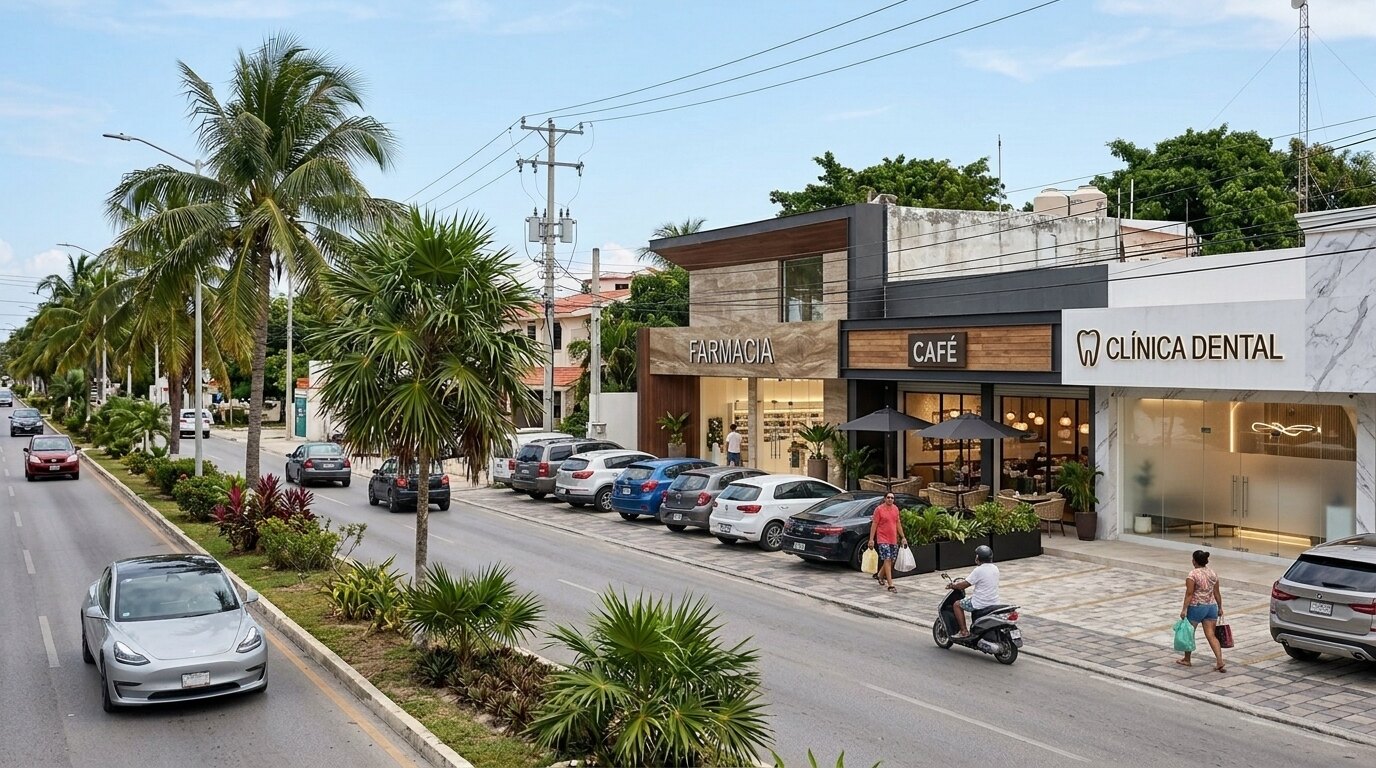
Almost every conversation about commercial real estate in Cancún starts the same way. Someone came down on vacation, saw the Hotel Zone packed in March, did some math on a restaurant napkin and thought: "there's business here." And there is. But the Cancún you see from a hotel pool is only one part of the city, and often it isn't the part where the best investment lives.
This guide is written for that person: someone with capital, interested in buying a retail unit, an office, a small hotel, a warehouse or a piece of land, who wants to understand the market before someone sells them a story. We won't promise returns. What we will do is explain how the city moves, where people most often go wrong and which questions save you headaches.
There are two Cancúns, and both pay rent
The first is the one everyone knows: the airport with more international flights than any other in Mexico, the Hotel Zone, restaurants that bill in dollars, tours, nightlife. It is an intense, seasonal market with high rents and a lot of tenant turnover.
The second is the Cancún where more than a million people live. People who work in those hotels, take their kids to school, go to the dentist, do their grocery run on Saturday. That Cancún spends every day, in pesos, along avenues like Kabah, Nichupté, Tulum and Huayacán. It never makes the postcards, but it is what keeps many shopping centers alive in September and October, when tourism dips.
The investors who sleep best usually have a foot in each. Or, better yet, they find properties that sit right on the border: a unit near a cluster of hotels that serves workers in the morning and visitors in the afternoon. Two kinds of customer, one square meter.
Before you look at properties, answer one question
Who is going to pay you?
It sounds obvious, but it is the question people skip most. If you are buying to lease, your customer is a tenant, and what matters is how easy it would be to replace them if they ever leave. If you are buying to run your own business, your customer is the end consumer, so what matters is whether they walk past your door, can park and come back. If you are buying land, your customer is a future developer, or you a few years from now, and what matters is what can legally be built there.
Each answer leads to different properties. We have seen buyers fall in love with a beautiful unit overlooking the lagoon, only to realize the business they had in mind, a clinic, had no reason to be in the Hotel Zone. And we have seen others buy an unremarkable unit in a neighborhood center that has been leased for years without a single empty month.
What's on the market, in plain words
Units in anchored centers. If the center has a supermarket, a chain pharmacy or a bank, the other units live off that traffic. These are boring assets in the best sense of the word. The risk: the anchor leaves, or the center's rules bar you from leasing to certain uses.
Street-front retail in the tourist zone. High rents, sometimes in dollars, and occupancy that rises and falls with the season. Works very well with a solid tenant; when the tenant isn't solid, the empty months hurt.
Offices and medical suites. There is steady demand from doctors, firms and tourism companies that need an administrative base. Small spaces of 50 to 150 m² lease more easily than full floors.
Small hotels. You're not buying a building, you're buying a business. If the seller can't show occupancy, average rate, licenses and payroll, there's nothing to talk about yet.
Warehouses. Beverage distributors, hotel suppliers, car rental companies. They care little about the façade and a lot about clear height, a maneuvering yard and whether a truck can get in without blocking the avenue.
Land. There are lots of lots; there are few good ones. The difference is zoning, utilities and clean ownership.
The year the map changed
2026 moved several pieces in Cancún. In May the Nichupté Bridge opened, connecting Boulevard Colosio with the Hotel Zone across the lagoon; according to authorities it cuts a rush-hour trip of almost an hour down to minutes. Midyear, construction began on a southern freight bypass that extends Avenida Huayacán to link the airport area with the highway to Playa del Carmen. And the Tren Maya is preparing its freight service, with a terminal in the city.
What does that mean for a buyer? Some areas that used to be "far" aren't anymore, and some businesses that lived off captive traffic will have to become destinations. It's not the moment to buy blind because of a headline, but it is the moment to look at the map with fresh eyes.
A word about numbers
You'll hear about returns. Plenty of them. Ten percent, twelve, eight in dollars. All of those numbers have one thing in common: someone calculated them with assumptions you don't know. Before believing any of them, ask for the leases, the receipts and the expenses, and do the math yourself. If it comes out lower than promised, it isn't necessarily a bad deal. But now you know what you're buying.
Five things we see go wrong
- Using the brochure rent. The rent that matters is in a signed lease and a bank statement, not the "market rent" someone estimated.
- Forgetting expenses. Property tax, center fees, hurricane insurance, maintenance and the occasional vacant month. Subtract them and the yield looks different.
- Visiting only in high season. The same unit in March and in October can feel like two different properties.
- Assuming the beach comes with the deed. The federal maritime zone is handled through a separate concession.
- Leaving the legal structure for last. If you're a foreign buyer, Cancún is in Mexico's restricted zone, so title has to be held via a bank trust (fideicomiso) or a Mexican-incorporated company. That gets decided before the promissory agreement, not at the notary's office.
A well-thought-out purchase, start to finish
Here's a made-up but very realistic case. An investor from Guadalajara wants a unit of about 120 m² to lease. The first thing she does isn't browse listings; it's ask who her tenant might be five years from now. A pharmacy, a dental office, a chain coffee shop. With that list in hand, she immediately rules out units hidden at the back of a center, units without parking and units on avenues where you can't make a U-turn.
She's left with four options on residential corridors. She asks for each one's leases, subtracts expenses, compares net income and visits every center on a Tuesday morning and a Saturday afternoon. In the end she doesn't pick the prettiest or the cheapest. She picks the one whose tenant would be easiest to replace if it ever left. It's a boring decision. It's also the one that lets her sleep at night.
The same reasoning works for a hotel or a lot. The questions change; the logic of starting with who's going to pay doesn't.
When we'd tell you to wait
Not everyone should buy commercial property right now, and that's fine to say. If you need the money available on short notice, a retail unit isn't the vehicle: selling it can take months. If your personal cash flow can't handle two or three months without rent, look for an asset with a long lease or an everyday-needs tenant. And if you live far away and have no one in the city to collect rent, deal with a leak or attend the center's owners' meeting, solve that before you buy. A good property badly managed turns into a bad property fast.
What if it shouldn't be Cancún?
Sometimes that's the honest answer. If what excites you is walkable retail, the kind that lives off people strolling with an ice cream in hand, Playa del Carmen has a dynamic Cancún doesn't replicate. If your idea is a design-led wellness hotel, Tulum serves that guest. And if you want a lower entry price without straying too far from the airport, Puerto Morelos is worth a look.
Cancún wins on one concrete thing: volume. More potential tenants, more buyers the day you want to sell, more data to compare. For many investors, that's worth more than any view.
If we had to sum it all up in one line: in Cancún, the best commercial investment is rarely the prettiest; it's the one somebody else needs to lease.
This content is for informational purposes only and does not constitute legal, tax, financial or investment advice. Before buying commercial property, land or investment property in Mexico, we recommend validating documentation, zoning, permits, restrictions, project feasibility and legal conditions with qualified professionals.
The images shown are for reference purposes only and may not represent reality.