
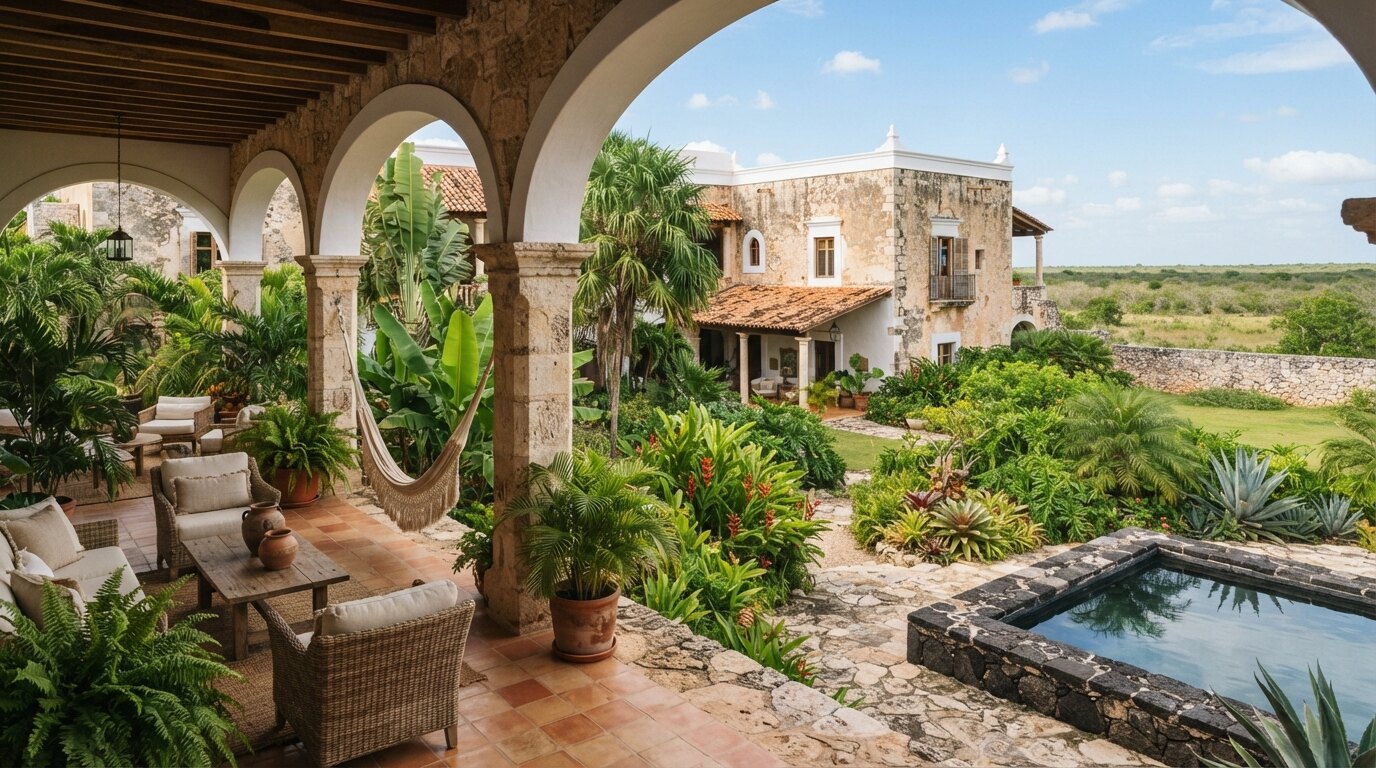
Yucatán’s commercial real estate story is bigger than Mérida. The capital is still the main economic engine, but serious investors should also pay attention to the coast, Valladolid, Panabá and the state’s interior corridors. These places do not all serve the same purpose. Some are tourism-led. Some are land banking plays. Some are development corridors. Some are better understood as long-term positions connected to infrastructure, culture and regional mobility.
This is where Yucatán becomes interesting as a portfolio market. An investor can study industrial land in Kanasín, a mixed-use site in northern Mérida, a ranch-hospitality property in Panabá and macrolots in Valladolid without forcing them into the same category. Each asset type responds to a different buyer profile and a different time horizon.
Selva Comercial’s Yucatán inventory shows that diversity clearly. Alongside industrial and office assets, the portfolio includes broader land opportunities through the Yucatán land section, such as a 98-hectare ranch with boutique hotel infrastructure in Panabá and several large Valladolid macrolots near development areas.
Valladolid is not Mérida, and that is the point
Valladolid belongs to a different logic than northern Mérida. It is smaller, more cultural, more connected to tourism routes and more influenced by regional mobility. For commercial land buyers, that can be useful. A macrolot in Valladolid is not competing with an office suite in Zona Norte. It is more likely tied to future development, tourism services, residential expansion, mixed-use concepts or land banking around a city with historical identity and connectivity advantages.
The listings around Valladolid show scale. A 229,053 m² macrolot, a 233,650 m² macrolot and a 290,712 m² macrolot require a different kind of buyer than a small retail operator. These are properties for developers, long-term investors or groups that understand phasing, infrastructure and market timing.
Panabá speaks to rural hospitality and land strategy
Panabá is not the obvious choice for every investor, and that is exactly why it deserves a more careful reading. A rural hospitality asset can be attractive when the buyer understands experience-driven travel, retreat formats, private ranch concepts, nature-based tourism, or long-term land value. It is not a product for someone who wants immediate urban foot traffic. It is a product for someone who can build a story around place, privacy and operation.
The 98-hectare ranch with boutique hotel and amenities in Panabá is a good example of that category. It is not only raw land, and it is not simply a traditional hotel. It sits somewhere between hospitality, ranch operation, event potential, retreat use and long-term land strategy.
The coast adds another layer to Yucatán’s commercial map
The modernization of Progreso gives the coast a stronger role in the state’s commercial conversation. Coastal land and port-adjacent demand are not automatically the same thing, but the relationship matters. More port capacity, more tourism movement and stronger logistics positioning can influence how investors think about hospitality, services, storage, distribution and commercial support functions.
For Yucatán, the coast should not be read only as beach lifestyle. It can also be read as a corridor where tourism, logistics, local services and long-term land values interact. This is especially important for investors comparing coastal or interior opportunities with industrial land in places like Kanasín or urban mixed-use assets near Mérida’s main commercial anchors.
How to compare very different Yucatán assets
The key is to avoid using one scorecard for everything. A Valladolid macrolot should be reviewed through development potential, phasing, surrounding growth, access and long-term absorption. A Panabá hospitality ranch should be reviewed through operations, experience design and destination fit. A Mérida office should be reviewed through visibility, tenant profile and urban demand. A Kanasín industrial lot should be reviewed through logistics, truck access and use.
A site in Mérida’s north may depend on established purchasing power. A mixed-use land site near Costco and Galerías Mérida may rely on existing commercial gravity. A Kanasín industrial parcel may depend on logistics growth. A Valladolid macrolot may depend on development timing. A Panabá ranch may depend on hospitality strategy.
The strongest Yucatán thesis is diversified but disciplined
Yucatán offers more than one investment story. That can be exciting, but it can also create confusion. The disciplined approach is to define the asset category first: industrial, urban commercial, office, tourism land, hospitality ranch, macrolot, coastal service or long-term land banking.
Selva Comercial’s role is to help buyers compare those possibilities without flattening them into one generic Yucatán opportunity. Start with the Yucatán property hub, then review specific lanes: Kanasín industrial land, Zona Norte office and commercial assets, Panabá hospitality land and Valladolid macrolots.
Explore Yucatán commercial land beyond Mérida.
Selva Comercial can help you compare industrial, hospitality, urban and development land opportunities across Yucatán.
The images shown are for reference purposes only and may not represent reality.