
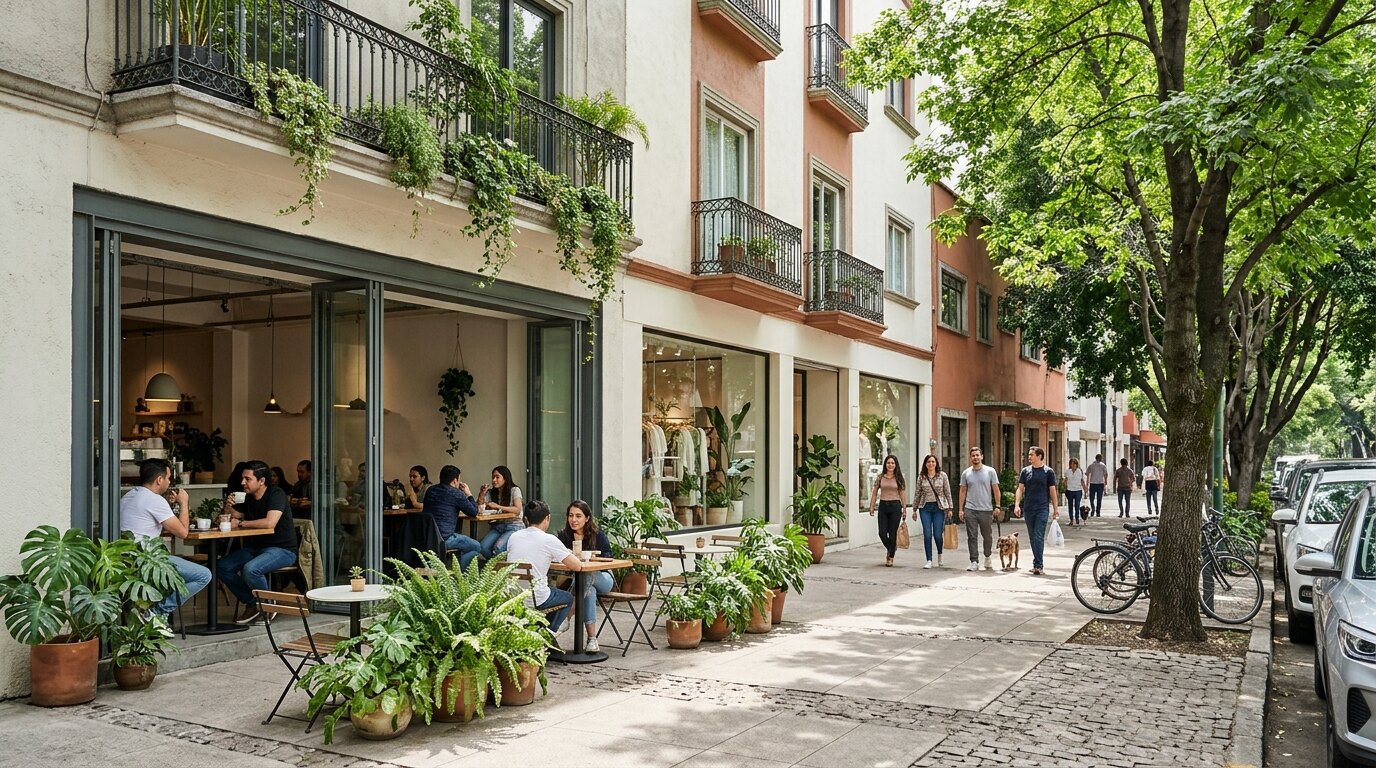
A street-level retail unit on a good corner in Mexico City looks like the simplest investment there is: you can see it, touch it, and people walk past all day. Yet many deals that go wrong in this segment do not fail on price or location but on a single document: the zoning certificate.
Anyone buying a retail space to lease out or to run their own business needs to know, before signing, what can legally happen there. A unit that only allows certain uses is worth something different from one that allows a restaurant serving alcohol, and that difference rarely appears in the listing. This guide explains how to read zoning in the capital from a practical angle. If you are already searching, you can browse retail and commercial spaces in Mexico City.
The document to request first
In Mexico City, the Ministry of Urban Development and Housing (SEDUVI) issues the Certificado Único de Zonificación de Uso del Suelo, the city's official zoning certificate. It states the lot's zoning under the current urban development program, which uses are allowed or prohibited, how many stories can be built and other applicable rules.
It can be requested in person or digitally, and under Mexico City's 2026 fiscal code the electronic version costs 2,104 pesos. Compared with the value of a retail unit, that is minimal. Even so, many buyers skip it and rely on what the seller says or on the current tenant's business.
That is the first mistake. A unit that houses a shop, pharmacy or café today does not necessarily have authorized use. It may be operating under the wrong permit or without one.
What to look for in the certificate
When reading the certificate, focus on three things:
- The zoning code. Common codes in the capital include HC (residential with ground-floor commercial), HM (mixed residential) and H (residential). Each allows different uses, and the use table in the relevant program defines which businesses fit.
- Specific rules. Some corridors have particular standards that expand or restrict uses, heights or parking.
- The exact lot. Confirm that the property tax account and address match the unit you are buying, especially in buildings with several units.
When the use predates current zoning
Some properties have run a business for decades that current zoning would no longer allow. For those cases there is a certificate of acquired rights, which recognizes a legitimate use that existed before the program changed.
That document can add significant value to a unit, because it allows a use a neighboring unit could no longer obtain. But read it carefully: it applies to a specific use and floor area, and it can be lost if the use is abandoned for a certain period. If the seller mentions acquired rights, ask for the certificate and check exactly what it covers.
Notice or permit: not every business opens the same way
Having the right zoning is the foundation, but it is not enough to operate. In Mexico City, business openings are registered in the commercial establishment system known as SIAPEM, and the route depends on the type of business.
Low-impact businesses, which include most small shops, open with an operating notice. It is free and registered immediately in the system, although the operator must comply with what they declare.
Businesses with neighborhood or zonal impact, such as restaurants serving alcohol, bars or event halls, need a permit. Among other documents, it requires the zoning certificate and a safety and operations approval signed by a licensed construction supervisor (Director Responsable de Obra). Depending on capacity, an internal civil protection program may also be required.
For a buyer, the takeaway is clear: a unit whose zoning allows higher-impact uses has a broader pool of potential tenants. One limited to low-impact uses has a narrower market, and its rent should reflect that.
What happens if you buy without checking
Borough authorities can inspect businesses and, if they find them operating without a notice or permit or with a use that is not allowed, impose penalties up to suspension or closure. For the owner of a leased unit, that means a tenant who leaves and a space that is harder to lease again.
There is also a value risk. If you bought with a restaurant in mind and the zoning only allows basic retail, you paid for potential that does not exist.
Beyond the paperwork: the unit itself
With zoning settled, the analysis moves to the property. These features most affect rent and how easily the space leases:
- Frontage. Meters of street frontage matter more than total square meters. Good frontage means more visibility and flexibility.
- Height and layout. A regular floor plate with good ceiling height accepts more uses and can fit a mezzanine or storage.
- Building systems. Electrical load, water, drainage and, for restaurants, the ability to install kitchen exhaust and a grease trap.
Also review the ownership regime (if the unit is in a condominium, check the bylaws, since some restrict uses), the property tax and water account status, and the neighbors. A unit in a building with condominium disputes can be hard to operate even if everything else is in order.
Buying with a tenant or vacant
Many retail units in Mexico City are sold with a tenant in place. The advantages are obvious: income from day one and proof that the location works. But it also means more documents to review.
Ask for the full lease, not a summary. Check term, rent, escalations, deposit, guarantees and, above all, what the lease says about a sale of the property: some include a right of first refusal for the tenant or clauses that remain binding on the new owner. Ask for recent payment receipts too. A tenant who often pays late is not stable income, whatever the lease says.
Also confirm that the tenant's business has its notice or permit in order. If it operates without paperwork, the risk you inherit is not only theirs: a closure leaves your unit empty.
A vacant unit, on the other hand, lets you choose the tenant and set terms, but it means months without income while it leases. That period belongs in the financial model from the start.
The purchase agreement and the notary
In the capital, deals are usually formalized first with a promissory purchase agreement and then with a deed signed before a notary public. The promissory agreement is the moment to put protective conditions in writing: that the purchase depends on obtaining a zoning certificate with a specific result, that the seller delivers the property free of debts, and that the deposit is returned if a condition is not met.
The notary will review title, request the lien certificate and calculate the taxes and fees for the transaction. That work is essential, but it does not replace a commercial review of the unit: the notary confirms the sale is legal, not that the space works for the business you have in mind.
Different areas, different logic
Mexico City is not one retail market. Corridors such as Polanco, Roma, Condesa or Del Valle draw restaurant and service tenants, with high rents and frequent turnover. Areas near offices depend on weekday traffic. Established residential neighborhoods support everyday retail, with more moderate rents but steadier tenants.
None is better by definition. The question is which tenant you are targeting and whether the lot's zoning allows it. A corner on a trendy corridor with restrictive zoning may perform worse than a modest unit in a residential neighborhood with broad mixed-use zoning.
A simple exercise helps ground that question: visit the unit at three different times, for example a Tuesday at noon, a Thursday afternoon and a Saturday. Watch how many people pass on the sidewalk, which neighboring businesses have customers and which are quiet, and whether parking or transit is nearby. That observation does not replace a market study, but it avoids surprises no document will show.
A suggested review order
First, request the zoning certificate and, where relevant, the acquired-rights certificate. Then review the deed, property tax, water and, in a condominium, the bylaws. With that clear, assess the unit: frontage, systems and general condition. Only at the end compare prices with similar units that have the same permitted use. Comparing a broadly zoned unit with a restricted one is comparing two different products.
To apply this order to real options, review the retail spaces available in Mexico City and request the zoning certificate for each one before moving forward.
This content is for informational purposes only and does not constitute legal, tax, financial or investment advice. Figures come from public sources available as of November 2026. Before buying commercial property, land or an investment property in Mexico, verify documentation, zoning, permits, restrictions, project feasibility and legal conditions with qualified professionals. The images shown are for reference purposes only and may not represent reality.